Category Archives: Hope Moor Wind Farm

The Structural Bias of Section 35

Imagine you are the banker at the start of a Monopoly game. You intend to distribute the money fairly, one note each. But before you begin, one player produces a card – allowed under new rules – that gives them half the money in advance. You continue to behave in an unbiased way – one note at a time – but the result is already tilted. This is a structural rather than personal bias – one that is built into the rules.

Section 35 works the same way in the Hope Moor planning process. It allows the developer to bypass the normal parish and county council stages and present the proposal directly to the Secretary of State. Although from there on the procedures remain neutral, the starting conditions are not. This article outlines the biases that creates – for example, showing how the process already favours the development over scrutiny – and what can be done to get some balance back into the decision making.

Continue reading

Saving the Yorkshire Dales Costs Just 1–2p a Week

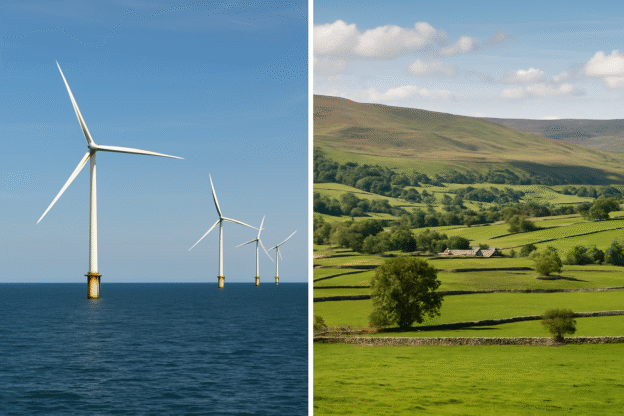
One of the main reasons for building wind farms onshore – rather than offshore – is cost. If the wind farm is constructed in the sea, it can double or triple the cost. Surely – the argument goes – building onshore is a no-brainer because it will keep electricity costs down.

But that argument is flawed because it considers only the construction cost, not the cost to consumers. Building offshore does not triple our electricity bills. The only question that matters is: how much do our bills actually increase?

To answer this question, I’ve calculated how much our electricity bills would increase if Fred Olsen’s industrial-scale wind farm was built offshore rather than – as they plan – across Hope, Kexwith, Holgate, Newsham, and Barningham Moors, which are prominently situated on the Yorkshire Dales skyline.

In practice, it adds only 1–2p per week to our electricity bills. But that needs to be set against the fact we would preserve the natural landscape and character of the Yorkshire Dales. Are we willing to pay 1–2p per week to prevent the industrialisation of the Yorkshire Dales landscape?

A supplementary question is how much would it cost if we built all future wind farms offshore. That is a more complex question, but I address that as well in this blog post.

Continue reading

Why Fred Olsen’s wind farm couldn’t be built in their home country, Norway

Norwegians expect wild landscapes to remain wild. Fred Olsen is a Norwegian company. But they are planning to build an industrial-scale wind farm on a narrow corridor of land between the North Pennines National Landscape and the Yorkshire Dales National Park. Although it technically sits on the boundary of the Yorkshire Dales, it imposes its presence up to 30 kilometres into the National Park.

Such a development could not be built in their home country of Norway because Norway’s national parks — and the wilderness zones that surround them — are governed by one of the strongest conservation frameworks in Europe. Under the Norwegian Nature Diversity Act:

  • industrial infrastructure is prohibited,
  • road-building is tightly restricted,
  • the overriding aim is to preserve wilderness character.

To my knowledge, there are no industrial-scale wind farms inside any Norwegian national park, nor in immediate areas adjacent to them. The idea of placing 200-metre industrial structures within sight of Hardangervidda, Jotunheimen, or Rondane would be regarded as politically unviable and subject to overwhelming opposition.

This is not just a legal matter; it reflects a deep cultural value — friluftsliv — the belief that access to unspoilt nature is essential to national identity, psychological wellbeing, and collective heritage.

Continue reading

Why Fred Olsen’s ‘outside the Yorkshire Dales’ reassurance is disingenuous

When announcing the proposed wind farm development at Hope Moor, the BBC reported that the developer – Fred Olsen –  ‘confirmed the scheme would be outside the boundary of the Yorkshire Dales National Park’. This is technically true but very misleading. The turbines stand just outside the boundary of the National Park but, as a Zone of Theoretical Visibility analysis clearly shows, the industrial-scale turbines would dominate long-established views across the north-eastern Dales.

The 20 turbines – not a typical size as the images on Fred Olsen’s website suggest – are of a different scale from anything we’ve seen in England before. Each turbine is as high as the UK’s biggest skyscraper outside London. They would be present inside the Dales visually, psychologically, ecologically, and environmentally. Our landscapes, bird flightlines, biodiversity corridors, etc. do not begin and end at the borders of the National Park. And when those borders were drawn for administrative purposes more than half a century ago, no one envisaged how such big turbines – twenty 200-metre turbines spread across 5km of skyline – could pose such an extensive threat to the landscape.

Continue reading

Fred Olsen’s wind farm: the hidden mental-health cost

The title of this blog highlights a hidden cost of Fred Olsen’s proposed wind farm that is in danger of receiving no attention: the mental-health impact of industrialising one of the nation’s most restorative landscapes. The debate around wind turbines nationally usually turns on carbon, grid capacity, energy costs or planning law. In the case of Fred Olsen’s industrial-scale wind farm on Hope Moor, the developer will also examine the trade-offs with ecological and environmental concerns — for example, arguing they are outweighed by the efficiency of 200m turbines.

But in the case of the proposal for a wind farm on the edge of the Yorkshire Dales, there is another important factor that we must not overlook — the nation’s mental health. There is mounting evidence from research that unspoilt natural landscapes support the nation’s mental health. When a proposal threatens to fundamentally alter one of those landscapes, the consequences are more than aesthetic. The UK is already in a mental-health crisis, and the Fred Olsen wind farm would push us further in that direction. And this mental-health dimension is almost always overlooked.

Continue reading